You go to the bathroom. You wait. Something moves — but not quite enough. You leave feeling like there is still something left behind — that never feel empty after bowel movement sensation that is hard to describe but impossible to ignore. You try again an hour later, and the cycle repeats.
The feeling of incomplete bowel movement is one of the most frustrating yet least talked about digestive complaints. It does not always come with dramatic symptoms — no doubling over in pain, no obvious food trigger. Just a persistent, uncomfortable feeling that your body is not finishing what it started.
If that description sounds familiar, you are not imagining it. And you are likely not alone in wondering why you never feel empty after a bowel movement despite eating reasonably well and staying hydrated. In most cases, this pattern points to something deeper: a disruption in digestive rhythm, nervous system regulation, and the communication between your gut and your brain.
This article covers the root causes of the feeling of incomplete bowel movements, why the connection between constipation, the nervous system, and gastric chemistry is so often missed, and natural approaches that address the pattern at its source—not just the surface symptom.
What is the Feeling of incomplete bowel movement?

The medical term for this sensation is tenesmus — a persistent feeling of needing to have a bowel movement even after defecation, often accompanied by the sense that the rectum is not fully empty. It is clinically recognized as a symptom of several digestive conditions, though the feeling of an incomplete bowel movement is common among people without a formal diagnosis.
The sensation can range from mild and occasional to chronic and disruptive. For many people, it becomes background noise — something they manage daily without ever recognizing it as a distinct pattern worth investigating.
Is It the Same as Tenesmus?
Tenesmus specifically refers to the urge to defecate without being able to do so fully, sometimes producing very little or nothing despite the sensation. The feeling of incomplete bowel movement is closely related, but the two are not identical. Tenesmus tends to be more urgent and uncomfortable. The incomplete sensation is often more subtle: you have moved your bowels, but the sense of completion is absent — you never feel empty after bowel movement, even when little or nothing remains.
Both patterns can share similar root causes, and the distinction matters primarily when ruling out more serious structural conditions.
When to Seek Medical Evaluation
This article focuses on functional and nervous-system-driven causes, which represent the majority of cases. However, it is important to note that certain presentations warrant medical evaluation: rectal bleeding, significant unexplained weight loss, sudden onset of symptoms in older adults, or changes in bowel habits accompanied by pain or fatigue that does not improve. If any of these are present, speak with your physician before pursuing functional approaches.
Why You Never Feel Empty After a Bowel Movement

The reason you never feel empty after a bowel movement is not simply about the volume of stool eliminated. This pattern involves a nuanced feedback loop between rectal wall receptors, pelvic floor muscles, and the enteric nervous system — the network of neurons embedded throughout the gut wall.
When this system is working well, the rectum empties, the muscles relax, and the sensation of completeness resolves. When it is dysregulated, that resolution signal either does not register clearly or does not arrive at all — which is why the incomplete bowel movement feeling can persist even when the bowel has technically emptied.
The Role of Rectal Sensation and Pelvic Floor Function
The rectum contains stretch receptors that signal the brain about the state of filling and evacuation. When these receptors are chronically overstimulated — as they can be in IBS-constipation patterns or in states of nervous system hyperactivation — the signal becomes unreliable. The brain continues to perceive fullness even after the bowel has emptied, perpetuating the feeling of incomplete bowel movement and the tenesmus bowel sensation.
The pelvic floor is equally central to the picture. When these muscles are tight or poorly coordinated — a pattern common in people who chronically hold stress in the lower body — they can physically block complete evacuation. This is known as dyssynergic defecation: instead of relaxing to allow passage, the muscles contract against it.
Stool Consistency and Incomplete Emptying
A stool that is too hard, too dry, or fragmented does not move through the rectum cleanly. This is often the result of slowed transit time — meaning stool spends too long in the colon, where water continues to be absorbed. This is one of the clearest connections between constipation, nervous system dysfunction, and the feeling of an incomplete bowel movement: chronic sympathetic dominance suppresses gastric acid and bile output, both of which are essential to normal transit. When those upstream signals are weak, stool consistency suffers downstream.
Root Causes of the Incomplete Bowel Movement Feeling
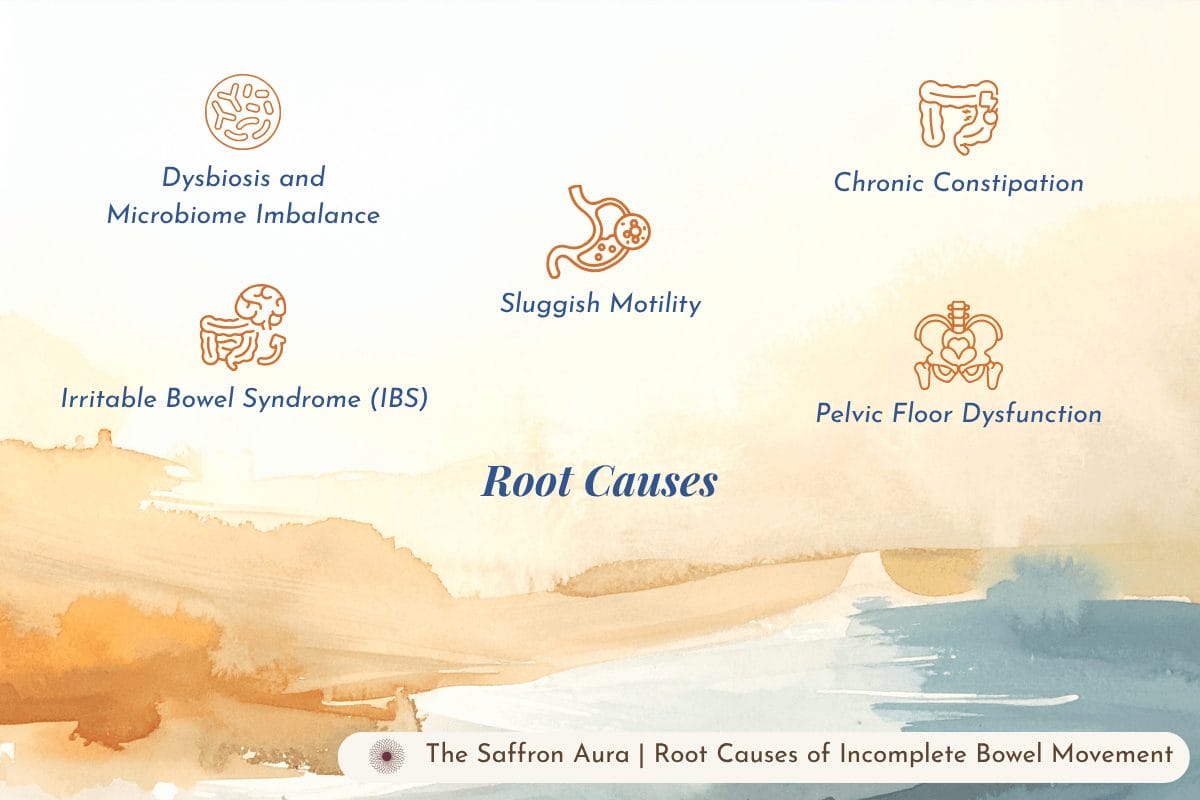
Chronic Constipation and Sluggish Motility
Sluggish transit — whether due to low fiber intake, inadequate hydration, a sedentary lifestyle, or a disrupted digestive rhythm — leads to incomplete emptying. Stool that has stagnated in the colon is harder to fully evacuate, and the mechanical act of straining can, over time, sensitize rectal receptors.
Irritable Bowel Syndrome (IBS)
The feeling of incomplete bowel movement is a hallmark complaint in IBS — particularly in the constipation-predominant and mixed subtypes. IBS involves both motility dysregulation and altered visceral sensation: the gut perceives normal input as uncomfortable, and the threshold for the perception of incompleteness is lowered. People with IBS-C often report never feeling empty even when stool volume is adequate, because the rectal signaling system has become hypersensitized. Tenesmus bowel symptoms are especially common in this subgroup.
Dysbiosis and Microbiome Imbalance
A disrupted gut microbiome affects motility through multiple pathways: reduced short-chain fatty acid production, altered serotonin signaling (the gut produces 90% of the body’s serotonin, which directly regulates intestinal movement), and changes in bile acid metabolism. When motility is compromised by microbial imbalance, incomplete evacuation becomes a predictable downstream effect.
Pelvic Floor Dysfunction
As noted above, pelvic floor incoordination is frequently overlooked as a contributing factor. It is particularly relevant for individuals who spend long hours seated, hold tension in the hips and lower back under stress, or have a history of childbirth, pelvic injury, or chronic straining. Pelvic floor physical therapy is an underutilized intervention for this pattern.
Structural Causes — When to Rule Out More Serious Conditions
In a minority of cases, the sensation of incomplete evacuation has a structural origin: rectal prolapse, rectocele (a bulging of the rectal wall into the vagina in women), or, less commonly, colorectal pathology. These require imaging or clinical examination to identify. If a thorough functional approach does not produce improvement, structural causes should be evaluated with your physician.
Why the Nervous System Is the Missing Piece

For most people who experience a chronic feeling of incomplete bowel movement — particularly those whose diets are relatively whole and whose basic habits are sound — the nervous system connection is the variable that has not been addressed. They never feel empty after a bowel movement, not because of what they eat, but because of how their nervous system regulates digestive function.
Digestion is fundamentally a parasympathetic function. It requires the body to be in a state of relative safety and rest to operate at full capacity. Gastric acid secretion, bile release, peristaltic movement, and rectal signaling all depend on parasympathetic tone — the rest-and-digest branch of the autonomic nervous system.
When the body is chronically operating in sympathetic dominance — the fight-or-flight state maintained by ongoing stress, high cognitive load, poor sleep, and emotional dysregulation — digestive function is systematically suppressed. This is not a metaphor. It is a measurable physiological effect that manifests as changes in motility, enzyme output, rectal sensitivity, and the accuracy of gut-brain signaling.
Sympathetic Dominance and Digestive Motility
Under sympathetic activation, smooth muscle contraction in the gut is inhibited, sphincter tone increases, and blood flow to digestive organs is reduced. The practical result is slower transit time, less coordinated peristalsis, and a higher likelihood of stool stagnation — all of which contribute directly to the feeling of incomplete bowel movement. This is the constipation-nervous system mechanism at its most direct.
The Vagus Nerve and Bowel Motility
The vagus nerve is the primary pathway through which the parasympathetic nervous system communicates with the gut. High vagal tone correlates with stronger, more coordinated gut motility, better rectal evacuation signals, and more accurate gut-brain communication. Low vagal tone— associated with chronic stress — is directly linked to constipation: colonic motility slows, rectal sensation becomes unreliable, tenesmus bowel symptoms emerge, and the feeling of incomplete bowel movement becomes a predictable result.
Supporting vagal tone is therefore not a peripheral intervention for vagus nerve constipation or the feeling of incomplete bowel movement. It is a central one.
HCL, Bile Acids, and the Stress-Motility Connection
One of the most overlooked pieces of the constipation nervous system puzzle is what happens to gastric chemistry under chronic stress. Hydrochloric acid (HCL) production in the stomach is a parasympathetic function — it requires the body to be in a rest-and-digest state to secrete adequately. When the nervous system is chronically sympathetically dominant, HCL output drops. Low stomach acid means food is not properly broken down before it reaches the small intestine, digestive transit slows, and stool quality deteriorates — setting the stage for this chronic pattern. Produced in the liver and concentrated in the gallbladder, bile is released when fat enters the duodenum — but that release is also gated by the vagus nerve. When the nervous system is chronically stressed, bile flow diminishes. This matters because bile acids are among the primary drivers of the migrating motor complex (MMC) — the rhythmic wave of contractions responsible for sweeping residue through the intestines between meals. A sluggish MMC means material lingers in the colon, transit slows, stool loses its form and moisture balance, and the feeling of incomplete evacuation becomes the new baseline.
This is why addressing HCL and bile support — through bitters, ginger, dandelion root, and digestive herbs that stimulate biliary flow — can be a meaningful intervention for incomplete movement, especially when the pattern has a stress-driven origin.
Natural Ways to Address the Feeling of Incomplete Bowel Movement

Restore Digestive Rhythm — Not Just Fiber
Dietary fiber remains relevant — but it works best when digestive rhythm is intact. Gradually increase soluble fiber (oats, psyllium, cooked vegetables, flaxseed) while ensuring adequate fat intake, which stimulates the gastrocolic reflex and bile flow. Avoid the common mistake of adding excessive fiber to a sluggish system — this can increase discomfort without improving motility.
Equally important: establish a consistent morning routine that supports the gastrocolic reflex — the natural increase in colonic activity that follows a meal. Warm water with lemon, a small breakfast, and unhurried time in the bathroom (ideally a squatting position or with a footstool) can meaningfully improve evacuation completeness over time.
Herbal Support for Motility, HCL, and Bile Flow
Several herbs have a long history of use in both Ayurvedic and TCM traditions for exactly this pattern — stagnant digestion, incomplete elimination, and a sluggish gut that lacks proper tone. Given the HCL and bile connection outlined above, the most effective herbal protocols for the feeling of incomplete bowel movement address both motility and upstream digestive chemistry, including the vagus nerve constipation and constipation nervous system drivers discussed above.
- Triphala: A classical Ayurvedic formula of three fruits (amalaki, bibhitaki, haritaki) that tonifies bowel motility, supports elimination, and gently addresses constipation without the dependency associated with stimulant laxatives. It works best taken in the evening with warm water.
- Ginger (Zingiber officinale): Prokinetic and HCL-stimulating. It activates gut motility, supports gastric acid secretion, and warms digestive fire (Spleen Yang in TCM). Taken before or with meals, it supports the peristaltic rhythm that keeps transit moving.
- Dandelion Root (Taraxacum officinale): A bitter herb that stimulates bile secretion and encourages release from the gallbladder, which activates the migrating motor complex and keeps colonic transit moving. Particularly useful when the constipation pattern has a stress-driven or nervous system origin.
- Fennel (Foeniculum vulgare): Antispasmodic and carminative. Relieves cramping associated with incomplete evacuation and supports relaxation of smooth muscle in the gut. In Ayurveda, it pacifies Vata — the dosha governing movement and transit.
- Slippery Elm (Ulmus rubra): Demulcent. Coats and soothes irritated rectal tissue, supports stool bulk and consistency, and reduces rectal hypersensitivity that can perpetuate the feeling of incomplete evacuation.
Clinical herbal support is most effective when the formula is matched to the individual’s specific pattern. A sluggish, cold, deficient pattern requires different herbs than a hot, reactive, or spasmodic one. A clinical herbalist can identify the right combination.
Nervous System Regulation as a Foundation
Addressing the feeling of an incomplete bowel movement at its root often means addressing the constipation nervous system dynamic first — before adding more fiber, more supplements, or more protocols. For many people, this is the missing piece — despite doing everything else right.
Practical foundations: eating without screens, phone, or rushing; three conscious breaths before meals to activate the parasympathetic; morning sunlight and consistent wake times to stabilize circadian rhythm; and evening practices that genuinely shift the nervous system out of sympathetic activation (gentle movement, warm baths, breathwork, journaling).
These are not “soft” interventions. They are physiological inputs that directly influence the gut-brain axis, vagal tone, and digestive rhythm.
Movement, Breathing, and the Pelvic Floor
Diaphragmatic breathing creates a massaging pressure on the abdominal organs with each breath cycle. Practiced daily — even five minutes of slow, deep belly breathing — this can support peristaltic movement and reduce pelvic floor tension. Gentle movement (walking after meals, yoga) supports motility through physical stimulation of the intestines.
If pelvic floor tension is a contributing factor, targeted stretches (happy baby pose, deep squat holds, hip flexor releases) can relieve the tension patterns that interfere with complete evacuation. For significant or persistent issues, pelvic floor physical therapy is worth pursuing.
When I see this pattern clinically, I assess three things first: vagal tone and nervous system state, HCL and bile sufficiency, and gut motility rhythm. The feeling of incomplete bowel movement is rarely a single problem — it is usually the downstream expression of all three being disrupted simultaneously. When we restore that rhythm through herbal support, nervous system work, and consistent daily rituals, the pattern typically resolves within 4 to 6 weeks.
If you have been struggling with this and nothing has worked, my clinical suggestion is to stop adding to your protocol and start asking what your body is still not safe enough to do. That shift in question changes everything.
For targeted digestive support, Daily Digest™ includes herbs specifically selected to warm digestive fire, stimulate bile flow, support motility, and address the stagnation pattern that underlies incomplete elimination.
From Frustration to Understanding

The feeling of an incomplete bowel movement is not imaginary. It is not a minor inconvenience to push through. And it is rarely fixed by more fiber alone.
When you understand what is actually behind the feeling of incomplete bowel movement — a constipation nervous system pattern, suppressed HCL and bile output, a migrating motor complex that has lost its rhythm, and a rectal signaling system that has lost its calibration — the path forward becomes clearer. Vagus nerve constipation, tenesmus bowel symptoms, and the never feel empty after bowel movement are all expressions of the same underlying dysregulation. Not more effort, not more protocols. A restoration of rhythm.
The gut knows how to complete its cycles. It just needs the conditions to be safe enough to do so.